Structured Data Preparation
Prepare product catalogue data using a repeatable Excel-based framework designed around Salesforce object relationships and import order.

Product & Data Operations
In DevelopmentTurn complex Salesforce product loading into a structured, repeatable bulk process.
A reusable implementation framework for preparing, validating and loading Products, Price Books, Price Book Entries, Features and related catalogue configuration without days of repetitive manual work.
Product Type
Implementation accelerator
Primary Use
Complex catalogue bulk loading
Delivery Model
Accelerator + consulting support
The Problem
Creating a Salesforce product can be straightforward. Creating hundreds of products together with their pricing, Price Book Entries, Features and related configuration is not.
Records often need to be created in a specific order, Salesforce IDs need to be carried into later imports, relationships need to remain intact and a single bad source value can cause entire batches to fail.
Without a structured process, large catalogue loads quickly become a mixture of spreadsheets, manual corrections and repeated Data Loader operations.
Proven Approach
Previous Enterprise Result
~200 products
loaded in around one hour of Data Loader operations
The structured process replaced a workflow that previously required several days of repetitive product and related-record creation.
Core Capabilities
The accelerator combines structured data preparation, Salesforce relationship mapping, validation and controlled bulk loading into a repeatable implementation process.
Prepare product catalogue data using a repeatable Excel-based framework designed around Salesforce object relationships and import order.
Map Products, Price Books, Price Book Entries, Features and related configuration before data reaches Salesforce.
Replace repetitive manual creation with controlled bulk operations using Salesforce Data Loader and structured import sequencing.
Identify missing references, invalid values and relationship problems before they become failed imports or incomplete catalogue records.
Create dependent records in the correct order so Salesforce relationships can be established reliably across large catalogues.
Validate the final catalogue after loading to confirm expected products and related records were created correctly.
How It Works
Review the target Salesforce structure, required objects, relationships, mandatory fields and business rules.
Structure source data into controlled templates designed around the required Salesforce records and relationships.
Check references, required values, duplicates and relationship dependencies before attempting the Salesforce load.
Create records in the correct dependency order using repeatable Data Loader operations and generated Salesforce identifiers.
Confirm expected Products, Price Book Entries, Features and related records were created correctly.
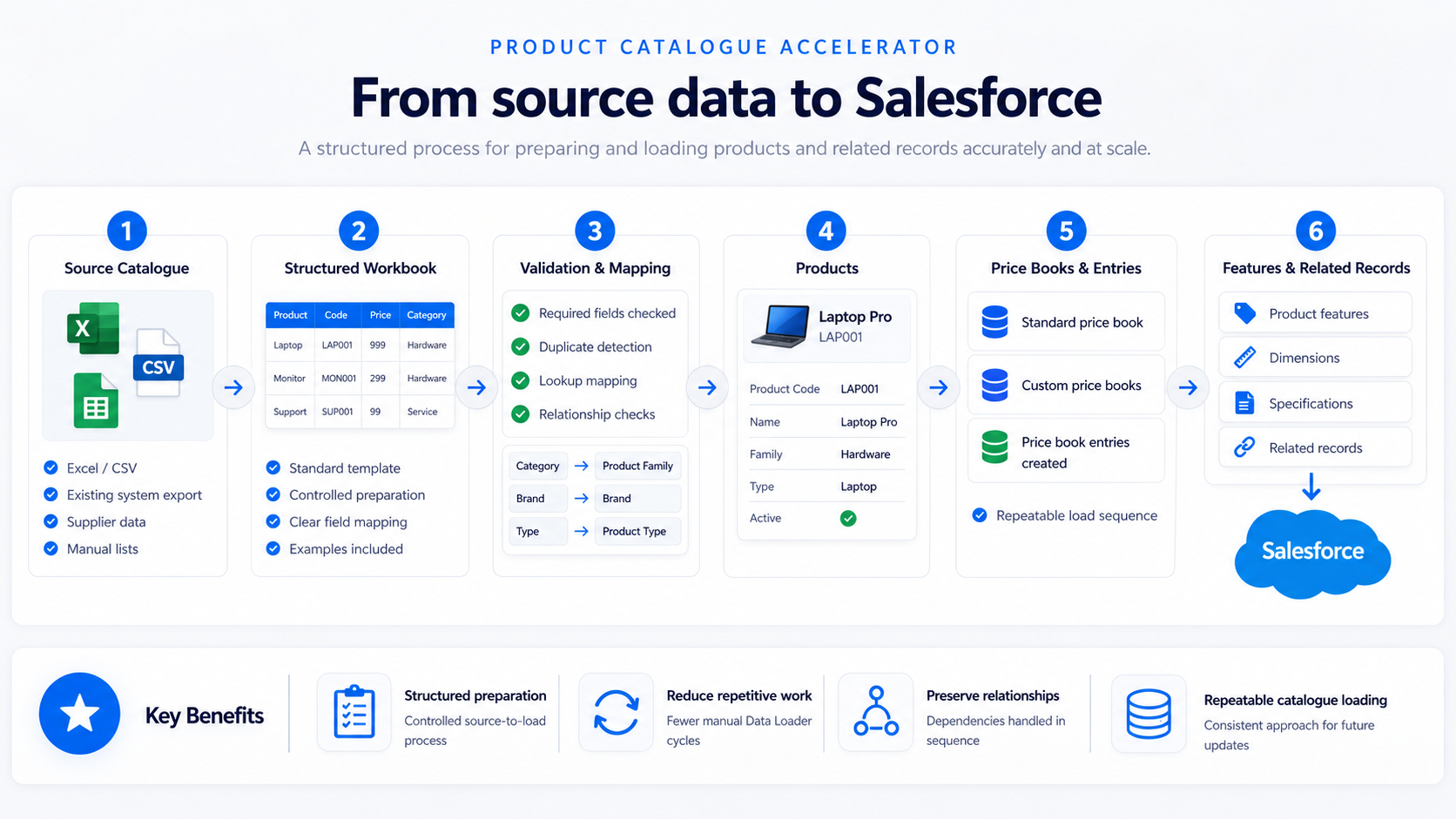
Catalogue Structure
The exact data model varies between organisations, but the accelerator is designed around the relationships that make Salesforce catalogue imports difficult in the first place.
Use Cases
Create hundreds of new Salesforce products and related records without building each catalogue entry manually.
Move structured product data from legacy systems, spreadsheets or existing platforms into Salesforce.
Rebuild or reorganise existing Salesforce product structures when pricing, relationships or catalogue design changes.
Support large-scale Salesforce CPQ product configuration where products depend on multiple related records and relationships.
Delivery Model
Unlike Org Change Monitor, the Product Catalogue Accelerator is initially intended to be delivered alongside consulting support rather than as a standalone licensed application.
Each organisation can have different product structures, required fields, custom relationships and validation rules, so the framework is configured around the target Salesforce environment.
Over time, more of the validation and import process may be automated into dedicated tooling as recurring catalogue patterns become clear.
Future Direction
The first commercial version focuses on rebuilding and improving the proven workbook-driven process. Future versions could progressively automate validation, transformation and Salesforce loading.
Stage 1
Reusable Excel templates, validation and controlled Data Loader operations.
Stage 2
Automated checks for relationships, required fields and invalid catalogue records before import.
Stage 3
Potential dedicated tooling to orchestrate catalogue loading with less manual Data Loader handling.
Catalogue Projects
If your team is facing hundreds of products, dependent records and repetitive import work, I’m interested in discussing how the accelerator could be applied to your Salesforce environment.